

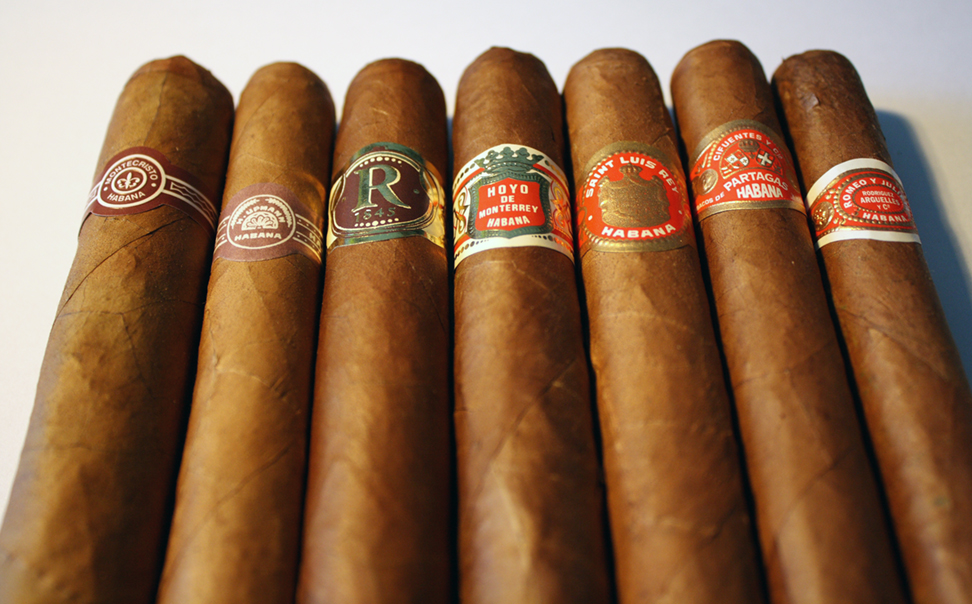
Walk into any shop humidor for the first time and you’ll be greeted by a wall of names that sound like either Italian sports cars or Dr. Seuss characters: Toro. Gordo. Lonsdale. Panetela. Everyone in the shop nods at these words like they’re ancient Latin, and for a while you nod too, quietly, hoping nobody asks you a follow-up question. Good news: the whole secret is two numbers — a length and a thickness — and once you know them, the entire wall starts talking. This is the field guide.
Two Numbers Explain Everything
Every cigar’s identity comes down to length in inches and ring gauge, which is the diameter measured in sixty-fourths of an inch. A robusto at 5 x 50 is five inches long and fifty sixty-fourths of an inch around — a shade over three-quarters of an inch. That’s it. That’s the entire code. Somewhere along the line the industry decided fractions of an inch were insufficiently intimidating and standardized on a system that makes a cigar sound like ammunition, and honestly? We respect it.
The formal word for a cigar’s shape and size is vitola, and the sizes with proper names are called vitolas de galera — gallery names, from the days when factory floor managers shouted them across the rolling galley. Those names still matter because a brand calling something “Churchill” is making a promise about dimensions, and like most promises, it’s approximately kept.
The Big Three (Plus the Blueprint)
Robusto (4½–5½” x 48–52) — the default setting of the modern cigar industry and for good reason: forty-five minutes, fits any break, big enough ring gauge for real blend complexity. The name means “strong” in Spanish, which is a misnomer — it describes the stubby shape, not the nicotine — but try telling that to your knees after a full-bodied one on an empty stomach.
Toro (6″ x 50–54) — the Goldilocks vitola and the one most blenders tune their flagship lines around. An hour of smoking, room for the blend to develop through thirds, and none of the commitment of the big boys. If you’re buying one cigar without a plan, this is the plan.
Gordo (6″ x 58–60+) — the sixtieth-of-an-inch crowd. Gordos run cool because that wide barrel pulls in lots of air, and the extra real estate lets more filler leafs into the blend. The trade-off: ninety minutes, a jaw workout, and a profile that can read a touch muted if the blender didn’t build for the width. Smoke one slowly. You’re not in a hurry; you’re holding a Gordo.
Corona (5½–6″ x 42–44) — the blueprint. Everything else on this list is a corona with a job title. Slim, elegant, honest, about an hour. Veteran smokers who have nothing left to prove tend to drift back to coronas, which tells you everything.
The Named Icons
Churchill (7″ x 47–48) — named for the man himself, who smoked Romeo y Julieta’s and made sure history knew it. Ninety minutes of statesmanlike smoking, and the only vitola named after a Nobel laureate that also pairs well with bourbon.
Lonsdale (6½” x 42–44) — named for the Earl of Lonsdale, the Victorian aristocrat who also gave his name to British boxing’s championship belt. A long corona with a sense of occasion. Out of fashion for decades, which — per the laws of style — means it’s due back any minute.
Petit Corona (4½” x 40–42) — the lunch-break cigar. Thirty minutes, no apologies.
Double Corona (7½–8½” x 49–52) — the two-hour smoke. Schedule accordingly, or become one of those people who abandons a cigar halfway, which is a sin we cover in the glossary under “don’t.”
Panetela (5–7½” x 34–38) — long and pencil-thin, the cigar equivalent of a dive bar martini. Once the most elegant smoke in the room; now mostly seen at weddings and in old movies, which is roughly the same thing.
The Shaped Ones (Figurados)
Torpedo / Pyramid (6″ x 52, tapered to a point) — the closed, pointed head funnels the smoke, focuses the draw, and requires a straight cut with actual aim. The only vitola with a dress code. Popular enough that we gave it its own leaderboard row.
Perfecto (bulged middle, closed at both ends) — the mustache of cigars: high-maintenance, old-fashioned, and unbeatable on the right face. You must cut the foot or it will not light, an experience every cigar smoker earns exactly once.
Culebra (three panetelas braided together) — the circus act. The story goes that factory workers were allotted a few cigars a day, and foremen got theirs braided — unsmokable, and therefore unsellable — so nobody could walk off with the good stuff. The flavor is the same; the point was never the flavor.
Does Size Actually Change the Taste?
Yes, and this is the part beginners miss. The same blend in a different vitola is a different cigar. Thin ring gauges are wrapper-forward — more wrapper leaf per puff, more of that leaf’s flavor — while wide ring gauges let the filler do the talking and smoke cooler. Length changes time, and time changes everything: the same blend that’s cedar and cream at minute ten has moved somewhere else by minute forty. When a review title on this site names the exact size, that’s not decoration. It’s the cigar’s actual name.
The Cheat Sheet
Tape this to the humidor. Or don’t; that’s what the glossary is for.
| Vitola | Size | Your Commitment |
|---|---|---|
| Petit Corona | 4½” x 42 | 30 min |
| Robusto | 5″ x 50 | 45–50 min |
| Corona | 6″ x 43 | 45–60 min |
| Toro | 6″ x 52 | 60 min |
| Lonsdale | 6½” x 43 | 60–70 min |
| Gordo | 6″ x 60 | 75–90 min |
| Churchill | 7″ x 47 | 90 min |
| Double Corona | 8″ x 50 | 120 min. Clear your afternoon. |
The next time the counter guy asks what you’re looking for, don’t reach for a name — reach for the clock. “I’ve got about forty-five minutes” is the most sophisticated sentence in cigars, because it means you already know what the wall is saying. And if you’ve got ninety and order the Gordo anyway? We’ll see you out there.










[…] Hyde is the 60-ring gordo of the Metropolitan Host family — 6 x 60, which is to say a cigar with a floor plan. Honduran […]